Euler's constant from geometry
Table of Contents
Recently Po Shen Loh made a post critiquing how American schools introduce Euler's number \(e \approx 2.7183\). Usually, it is presented in a financial context via the continuous compound interest formula
\begin{align} \label{eq:bernoulliformula} e = \lim_{n \to \infty}\qty(1 + \frac{1}{n})^{n}. \end{align}This approach has a clear benefit: it gives teachers an immediate answer to "why is all this math useful in real-life?"
Yet, the point of math education at middle- and high-school levels is to teach problem-solving. Unfortunately, at the level its introduced, students are simply not equipped to actually solve problems with infinite limits—that's what calculus is for, which many never take. So, scores of students are left with an impression of \(e\) as mysterious and magical.1
In contrast, other famous irrational numbers like \(\pi\) or even \(\sqrt{2}\) are taught from concrete, geometric problems. This blog post tries to put \(e\) on similar footing, starting with geometry and calculus and arriving at the familiar compound interest formula only at the end.
Geometry → Special functions
Often math invents new operations—special functions—to solve geometry problems. For example, the Pythagorean theorem
\begin{align} \label{eq:pytha} a^{2} + b^{2} = c^{2} \end{align}comes from the geometry of a right triangle with side lengths \(a, b, c\).
We define the square root function to solve for \(c\)
\begin{align} \label{eq:pythasqrt} c(a,b) = \sqrt{a^{2} + b^{2}}. \end{align}Similarly the unit circle consists of all points \((x,y)\) with
\begin{align} x^{2} + y^{2} = 1. \end{align}Solving for \(y(x)\)
\begin{align} \label{eq:circle} y(x) = \sqrt{1-x^{2}} \end{align}we can now find the area of a circle by computing the area under the curve \(y(x)\) \eqref{eq:circle}
\begin{align} \label{eq:circlearea} A = 4\int_{0}^{1} \sqrt{1-x^{2}} \dd{x} = \frac{\arcsin(1)}{2} \end{align}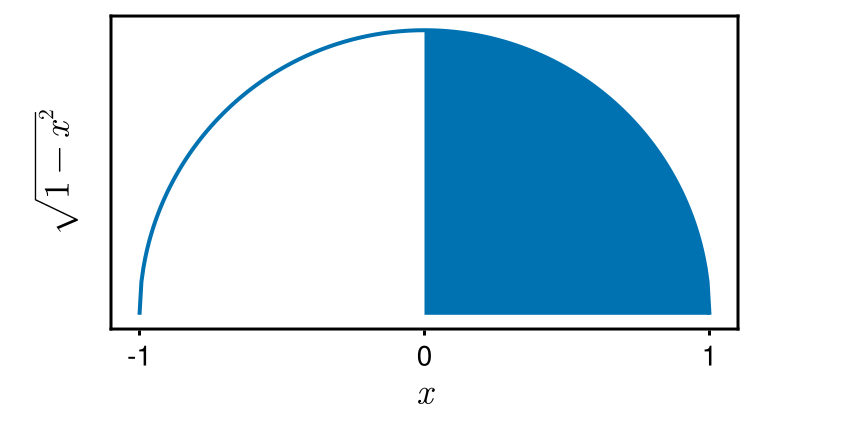
The integral in \eqref{eq:circlearea} is given in general by the special function \(\arcsin\), so we are led to a definition of the constant \(\pi\):
\begin{align} \label{eq:pidef} \pi := 2 \arcsin(1). \end{align}The equation \eqref{eq:pidef} is exactly the definition that "\(\pi\) is the area of a circle with radius 1", expressed as a mathematical equation using the special function \(\arcsin\), which we view as an operation that numerically answers a geometric problem.
Logarithms and Euler's constant
Let's try the same approach with a new curve: the hyperbola \(y(x) = 1/x\), defined for \(x > 0\). The area under the curve from \(1\) to some point \(x\) is given by
\begin{align} \label{eq:hyperbolaarea} A(x) = \int_{1}^{x} \frac{1}{t} \dd{t} \end{align}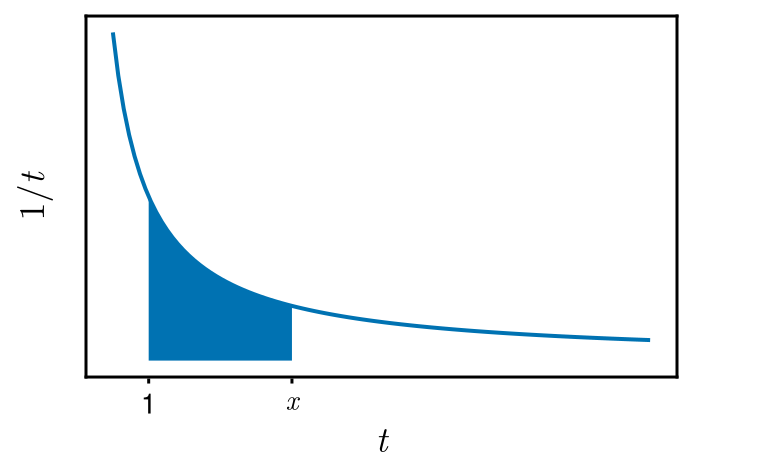
We don't know how to evaluate this integral, but we can simply define it as a new special function
\begin{align} \label{eq:logint} \ln x := \int_{1}^{x} \frac{1}{t} \dd{t} \end{align}called the logarithm. Even without computing it, we can see qualitatively that: the area is positive for \(x>1\), zero at \(x=1\), and strictly increases as \(x\) increases.
So there must be some number \(e > 0\) for which
\begin{align} \label{eq:euler} \ln e = 1. \end{align}Let's define the inverse of the logarithm as the exponential \(\exp\)
\begin{align} e := \exp(1). \end{align}Now we have an exact parallel to the definition of \(\pi\) in \eqref{eq:pidef}: both constants arise from integrals that compute geometric quantities (areas under curves) and both require special functions to express the answers.
What's this all got to do with exponentiation?
So, we have a definition of \(e\) as it relates to the area under a hyperbola. At this point, \(e\) has nothing to do with exponentiation—but we should expect this. The fact that \(\pi\) is defined by circle geometry doesn't immediately connect to side length ratios of right triangles either. To make this connection, we have to actually study the trigonometric functions, not just define them. In our case, we study \(\exp\) and \(\ln\).
It turns out that logarithms have a surprising property: if we rescale the length dimension of the hyperbola in \eqref{eq:logint} by \(a\), the area scales as
\begin{align} \int_{x_{1}}^{x_{2}} \frac{1}{t} \dd{t} = \int^{a x_{2}}_{a x_{1}} \frac{1}{t}\dd{t} \end{align}from which one can derive2 the miraculous property
\begin{align} \ln(xy) = \ln x + \ln y. \end{align}This identity—discovered by John Napier in 1614—is what made logarithms important in the first place: they turn multiplication into addition. This means that the inverse of the logarithm must turn addition into multiplication!
\begin{align} \label{eq:explaw} \exp(x + y) = \exp(x)\exp(y). \end{align}With this property and the fact that the special functions \(\exp\) and \(\ln\) are defined for real numbers, we can generalize the definition of exponentiation beyond integers: for any base \(b>0\),
\begin{align} b^{x} := \exp(x \ln b). \end{align}If \(x\) happens to be an integer, we recover the usual definition, for example if \(x = 3\)
\begin{align*} b^{3} &= \exp(3 \ln b) \\ &= \exp(\ln b + \ln b + \ln b) \\ &= \exp(\ln b) \cdot \exp(\ln b) \cdot \exp(\ln b) \\ &= b \cdot b \cdot b. \end{align*}While we have defined \(\exp, \ln\) geometrically, we can derive the important property \eqref{eq:explaw} which connects \(e\) with the operation of exponentiation as repeated multiplication.
Bernoulli's compound interest formula
We can now answer the classical question: given an annual interest rate \(R\), what is the equivalent continuously compounded interest rate \(r\)? That is:
\begin{align} 1+R = \lim_{n \to \infty}\qty(1 + \frac{r}{n})^{n}. \end{align}Taking logarithms,
\begin{align} \ln\qty[ \qty(1+\frac{r}{n})^{n}] = n \ln(1 + \frac{r}{n}). \end{align}For large \(n\), \(r/n\) is small and we can estimate3
\begin{align} \ln(1 + \frac{r}{n}) \approx \frac{r}{n} \end{align}and we have
\begin{align} \ln(1+R) = \lim_{n \to \infty} n \ln(1 + \frac{r}{n}) = r \end{align}therefore taking \(\exp\) of both sides gives
\begin{align} 1 + R &= \exp(r) \end{align}as we saw in the beginning with \eqref{eq:bernoulliformula}.
A function-first pedagogy
The conceptual and mathematical motivation for studying \(e\) depends on ideas from calculus. Still, it's possible to present the special functions \(\exp, \ln\) without it, in the same way trigonometric functions are presented, focusing on its algebraic properties like \eqref{eq:explaw}. Given their importance in e.g., defining pH in high school chemistry, deferring until a proper calculus course may be impractical.
But, at the very least we can emphasize \(\exp\) and \(\ln\) as proper functions, as we do with \(\sin, \cos, \tan\), instead of as a generalization of exponentiation as repeated multiplication. This latter fact is a property of the special function, not its definition.4 Then, near the end of the curriculum, students can be introduced to formulas like Bernoulli's or the differential equation
\begin{align} \label{eq:diffeq} \dv{x} f(x) = f(x) \end{align}without the expectation that they should mathematically evaluate any infinite limits.
Math formulas are intimidating when divorced from the necessary context and intuition. For trigonometric functions, this intuition comes from the simple geometry of circles and right triangles. Unfortunately, for \(\exp, \ln\) this intuition comes only from the infinitesimal calculus of derivatives and integrals. Ideally, American math education should wrestle with this in an intelligent way.
Footnotes
Not even mentioning the even more mystical
\begin{align} e^{i \pi} = -1 \end{align}which abounds in "pop math" Youtube.
For \(x_2 \geq x_{1} > 1\), we have
\begin{align*} \ln(x_{1}x_{2}) &= \int_{1}^{x_{1}x_{2}} \frac{1}{t}\dd{t} \\ &= \int^{x_{1}}_{1/x_{2}} \frac{1}{t} \dd{t} \\ &= \int_{1/x_{2}}^{1} \frac{1}{t} \dd{t} + \int_{1}^{x_{1}} \frac{1}{t} \dd{t} \\ &= \int_{1}^{x_{2}} \frac{1}{t} \dd{t} + \int_{1}^{x_{1}} \frac{1}{t} \dd{t} \\ &= \ln x_{2} + \ln x_{1}. \end{align*}This follows if one derives the Taylor series for \(\ln\), alternatively one can proceed from the integral definition, using the left Riemann sum estimate
\begin{align} \int_{x_{1}}^{x_{2}} f(x) \dd{x} \approx (x_{2} - x_{1})f(x_{1}). \end{align}which is accurate if \(x_{2}\) is very close to \(x_{1}\). Then,
\begin{align} \ln(1 + x) = \int_{1}^{1+x} \frac{1}{t}\dd{t} \approx x. \end{align}For comprehensiveness, I will note that the left Riemann sum isn't special: the right Riemann sum works just as well at this level of approximation
\begin{align} \ln(1 + x) &= \int_{1}^{1+x} \frac{1}{t}\dd{t} \approx x(1+x) \\ &\approx x \end{align}by neglecting the \(x^{2}\) term which is much smaller than \(x\).
In order to take the identity \eqref{eq:explaw} as a definition, we need to show that \(\exp\) is the unique function that satisfies it among some class. In fact this is true for the class of continuous functions… showing this fact is probably not an effective teaching plan at the high school level. There is a simple sketch of this idea if we consider only differentiable functions \(f\) (and know the theory of differential equations). Then,
\begin{align} f(x+0) = f(x)f(0) \end{align}implies that \(f(0) = 1\). Next,
\begin{align} \frac{f(x+y) - f(x)}{y} = \frac{f(x)\qty[f(y) - 1]}{y}. \end{align}As \(y \to 0\), we have
\begin{align} f'(x) = f(x)f'(0). \end{align}This is the differential equation of \eqref{eq:diffeq} which defines the exponential function, its solution is
\begin{align} f(x) = \exp(cx) \end{align}where \(c = f'(0)\) is just our choice of what to call the derivative of the function \(f\) at zero.